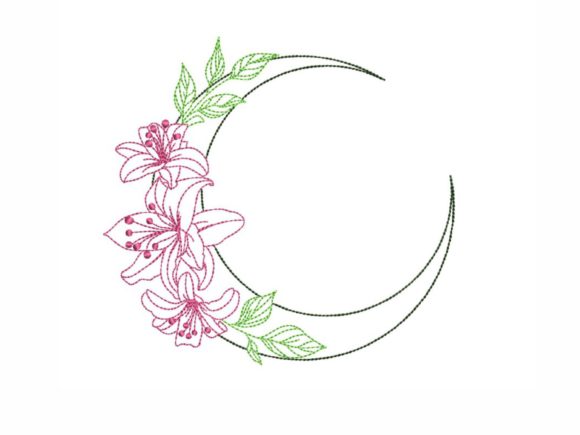
Floral Moon: A Thoughtful Designer’s Review
As someone who’s stitched hundreds of designs for clients, boutique launches, and Etsy bestsellers, I opened Floral Moon expecting charm—and got something more: quiet confidence. It’s not flashy. It doesn’t shout. But it holds space beautifully—like a whispered compliment on a well-made tote bag or the gentle accent on a baby onesie that makes new parents pause and smile. That’s the real test: does it feel intentional, not just decorative?
Mood & First Impressions: Delicate, Not Dainty
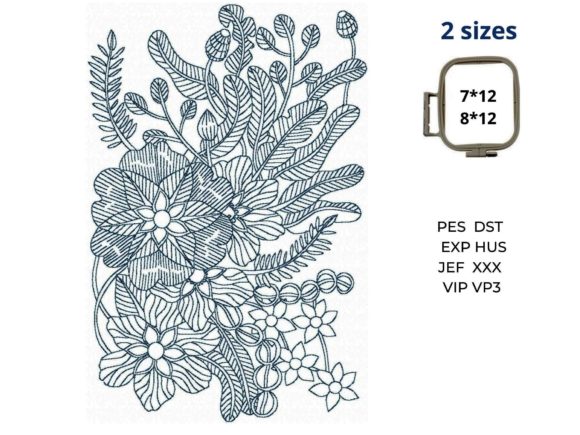
Floral Moon lands with soft authority. The moon isn’t a bold crescent—it’s subtle, slightly asymmetrical, and drawn with clean, graceful curves. The outlined flowers orbit it like quiet companions: no petals overcrowded, no stems tangled. This is Outline Flowers done with restraint. There’s breathing room between elements, which means it won’t vanish into fabric texture or get lost in stitching noise. It reads clearly at 3–4 inches wide—a sweet spot for sweatshirt embroidery, pillow covers, and embroidered patches meant to be seen, not scrutinized.
Where It Shines (and Why Clients Love It)
I recently used Floral Moon on a set of organic cotton tea towels for a local kitchen boutique. No fill stitch, no dense satin borders—just clean running and outline stitches. The result? A handmade product that looked elevated but never fussy. Customers responded to its calm elegance—not “cute,” not “trendy,” but timeless enough for gifting, distinctive enough for branding.
- Custom apparel: Works cleanly on midweight sweatshirts and structured tote bags—no puckering, no thread nesting, even with light stabilizer.
- Baby embroidery: Perfect for onesies and burp cloths. The open layout avoids stiff, bulky areas that irritate sensitive skin.
- Holiday & wedding gifts: Paired with ivory thread on oatmeal linen, it reads as thoughtful—not thematic. Ideal for bridal party robes or baby shower towels.
- Etsy seller & small shop product: Photographs beautifully in natural light. Looks premium in printable mockups without heavy editing.
- Commercial embroidery: Low stitch density means faster run times and less wear on machines—practical for small-batch production.
Where to Pause & Plan Ahead
Don’t assume Floral Moon is universally forgiving. Its strength is also its limitation: those fine outlines demand attention in certain contexts.
On thin or stretchy fabric (like lightweight knits or rayon challis), you’ll need cutaway stabilizer—not tear-away—to prevent wobble in the moon’s curve or flower stems. On dark fabric, test thread contrast first: pale ecru or silver can disappear; charcoal gray or navy thread adds weight without heaviness. And avoid cramming it onto curved surfaces like cap fronts unless you’ve confirmed hoop clearance—those outer flower tips may lift or distort if the design sits too close to the seam or bill edge.
It’s also not ideal for tiny hoop sizes under 4” x 4”. The composition needs space to land. Shrinking it below 2.5” risks losing definition in the moon’s contour and stem connections. Likewise, skip it for layered garments (think double-knit hoodies) unless you’re willing to float stabilizer underneath—the design lacks the structural density to bridge gaps.
What It Does for Your Brand & Buyer Trust
Here’s what matters most when you’re selling: Floral Moon makes your finished product feel considered, not assembled. When a customer sees it on a personalized gift, they don’t think “generic embroidery file.” They think “this person chose something with care.” That perception boosts perceived value—especially for handmade product listings where storytelling and authenticity drive decisions.
For Etsy sellers, it supports brand consistency across collections: pair it with minimalist typography or neutral thread palettes, and it becomes part of a visual language—not just a one-off design asset. And because it avoids cliché (no glitter, no cartoonish blooms), it scales gracefully—from nursery decor to women’s apparel lines—without needing rebranding.
Practical Designer Notes Before You Stitch
This isn’t just about loading the file and going. Real-world execution starts with prep:
- Test on scrap fabric first—same type, same stabilizer, same thread colors you plan to use.
- Review stitch density in your embroidery software. If the file includes optional fill elements, decide whether they support or compete with the outline aesthetic.
- Confirm hoop size compatibility. Don’t guess—measure the design’s bounding box against your smallest working hoop.
- Inspect small details: Are flower centers fully digitized? Is the moon’s curve smooth at slow speeds? Zoom in before stitching.
- Try black-and-white mockups. Does it retain shape and balance without color? If yes, you’ve got strong design bones.
- Compare light/dark backgrounds. What thread works on cream linen may vanish on charcoal twill.
- Use proper stabilizer—especially for textured fabrics like terry cloth or bouclé. Outline-only designs rely on foundation stability.
- Check licensing before selling finished items or bundling the digital embroidery file. Commercial use isn’t automatic—even for simple outline designs.
Bottom line? Floral Moon earns its place in a working designer’s library—not because it’s complicated, but because it’s quietly competent. It doesn’t ask for attention. It earns it, stitch by deliberate stitch.